What Is Traditional SEO?
Search engine optimization (SEO) is the process of influencing the visibility of a web page in a search engine’s unpaid results. SEO has been focused on how to get content to rank in the search engine results pages (SERPs) for certain keywords through backlinks, technical SEO, and user experience signals.
Today, this approach is evolving with AI Search Optimization, where search engines use artificial intelligence to understand intent, context, and content quality rather than relying only on exact keywords. Modern SEO now requires creating content that aligns with how AI-powered search systems interpret relevance, authority, and user satisfaction, not just how algorithms count links or keywords.
Traditional SEO is:
Investigating and selecting the appropriate keywords
Elements on the page such as titles, headings, meta descriptions, etc.
Technical SEO involves things such as site speed, mobile friendliness, and how easily a site can be crawled.
It also adds off-page SEO around backlinks and authority building.
They both have had been the (relatively non-complicated) same goals: Rank higher on a search engine which sends more traffic to your site.
This was considered to be the ideal workflow since search engines basically returned lists of links. As algorithms became more complex, the core layout always remained the same. People searched, Google ranked pages, and websites competed for the top spots.
The system is now changing.
What Is GEO (Generative Engine Optimization)?
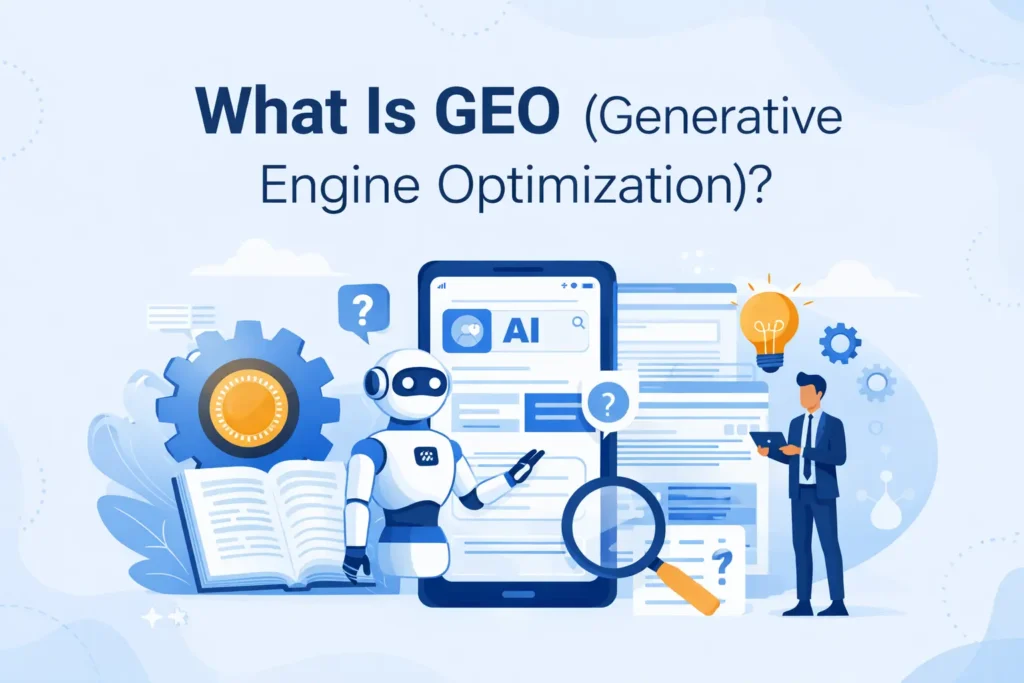
Generative Engine Optimization (GEO) is a new approach to search optimization that focuses on aligning content with AI-driven search systems that generate direct answers instead of displaying a simple list of links. With the rise of generative AI in search engines, AI assistants, and conversational search tools, information is now distilled and delivered straight to the user.
Instead of asking, “Which page should rank first?” Generative Engine Optimization shifts the focus to “What is the best possible answer to this question?” AI search systems evaluate content based on relevance, clarity, authority, and usefulness rather than traditional ranking signals alone.
GEO is the practice of making content AI-model readable, trustworthy, and contextually rich, enabling generative engines to:
- Read and accurately summarize content
- Synthesize answers from multiple sources to deliver more complete responses
- Provide direct answers to user queries without forcing a click to a website
This is a fundamental shift. Ranking positions are no longer what visibility is bound to. Whether your content is “picked” or quoted or referenced by an AI-generated answer.That’s where AI Search Optimization (AISO) comes into play
The Core Difference Between GEO and SEO
The biggest difference between GEO and SEO is not the tools or tactics. It’s the way that search engines think.
SEO is optimized for paged ranking algorithms.
GEO is optimized for AI-based answer generating systems.
In SEO:
You optimize for keywords
You fight for clicks.
The ranking position is most important.
In GEO:
You optimize for clarity and authority
You fight to be included in AI answers.
Ranking is less important than being cited or summarized.
SEO wonders, “How do I get to the top?”
GEO wonders, “How do I be the source?”
That shift is everything from the way content is written to the way success is quantified.
How AI-Driven Search Actually Works
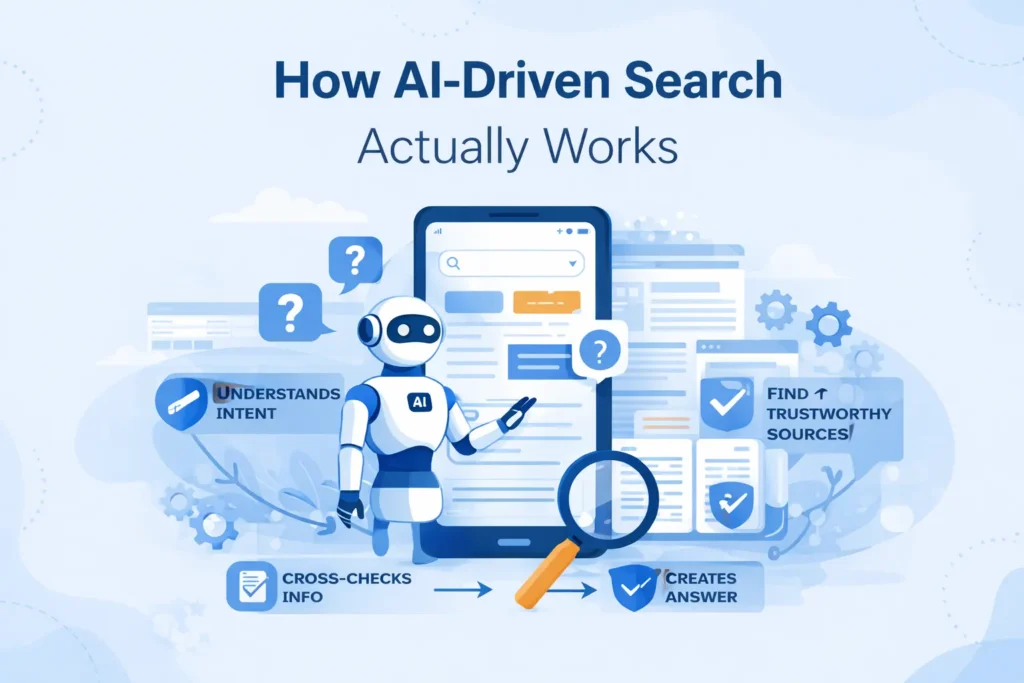
Fueled by AI, search engines sift through massive volumes of data to decipher intent, context, and semantics. They are no longer just matching keywords, they process questions much like a human would.
When users search with natural, conversational language, AI systems involved in AI Search Optimization:
- Decompose the intent behind the query
- Check and compare information across multiple trusted sources
- Identify trustworthy, corroborated data
- Generate a clear, summarized response
As a result, content created purely for keywords is often ignored. In contrast, well-structured, clearly explained content performs better within AI Search Optimization frameworks.
AI Search Optimization focuses on making content easy for AI systems to understand and reliable enough to be used directly in the answers they generate.
Why Keyword-Only SEO Is Losing Power
Keywords still matter, but now their role is different.
Before, diving into a keyword a certain number of times in a certain place could boost your content up the rankings. Now, AI systems focus more on:
Topic coverage
Semantic relevance
Contextual accuracy
User satisfaction
A page in natural language that just happens to perfectly answer a question can do better than a page that is over-optimized for a single keyword (“aggressively optimized” is really what it means).” said Mueller, in most recent video .
This is why SEO-only strategies that are predicated on machines can actually be harmful to your business are failing according to many experts these days. They’re optimizing for machines that don’t exist in quite the same way anymore.
Search powered by AI favors content with a human voice, clear explanations and expert knowledge.
Content Creation in GEO vs SEO
A lot of seo-content is so structure and optimisation heavy that readability comes second or even third AI Search Optimization.
GEO content reverses that philosophy AI Search Optimization.
For generative engines, content must AI Search Optimization:
Provide direct answers to questions AI Search Optimization
Use unnecessary headings and have a logical flow AI Search Optimization
Accurate information up-to-date with the latest news.
Stay away from filler AI Search Optimization
Artificial intelligence models prefer content that explains, not sells. Too much sales talk makes a page less likely to be cited as a source AI Search Optimization.
But that doesn’t mean marketing is dead. It means marketing needs to be a part of value-based content rather than pushed through keywords.
Authority and Trust Matter More Than Ever
Among the biggest shifts that AI-powered search brings is the focus on trust.
AI technologies are trained not to produce misinformation. That means they prefer content that:
Is sourced to credible sources
Demonstrates expertise and trustworthiness
Is consistent with known truth
Backlinks still count, but brand authority, topical relevance, and content quality count for more.
If your site regularly publishes accurate, well-organized information on a particular subject, AI systems are more likely to cite it.This is a key pillar of AI Search Optimization
Traffic Is No Longer the Only Metric
It’s a tough truth that a lot of marketers don’t want to face.
AI-powered search can decrease site visits.
When AI provides a direct answer to a question, users may never click a link. That doesn’t mean your content didn’t do well. Just that success needs to be defined differently.
In the GEO era, success includes:
Cited or referenced by AI systems
Brand visibility inside generated answers.
More trust and authority.
Indirect conversions and brand recall.
SEO was all about clicks. GEO is about influence.
Savvy marketers play both sides.
Does SEO Still Matter?
Yes. To throw out SEO altogether would be to throw out the baby with the bathwater.
SEO lays the groundwork that GEO builds on. Without:
Good site structure
Crawlable pages
High page-speeds
Clear topical relevance
AI systems may never discover or trust your content.
Consider SEO as the infrastructure and GEO as the broadcast layer.
You need both.
How AI Search Optimization Connects SEO and GEO
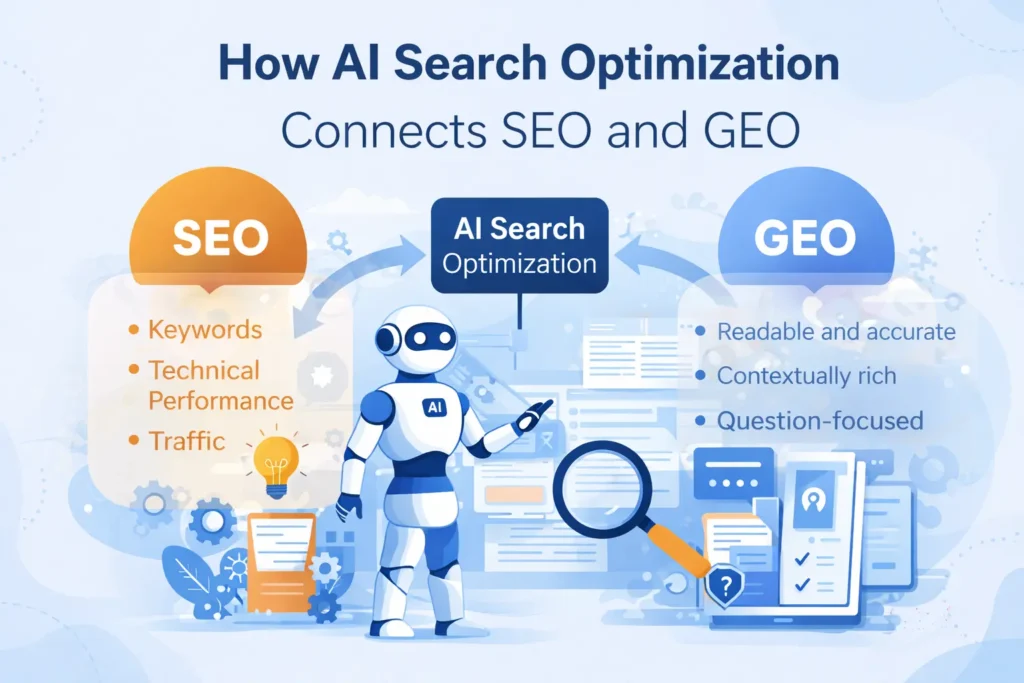
AI Search Optimization is where the disciplines of SEO and GEO meet. It is a combination of technical SEO with clarity and authority in content.
Good AI-Search-Optimization is the result of:
Content organization for human and AI content.
Being thorough rather than shallow in what they cover.
Speak like a Human: Forget Keywords Stuffing, Use Natural Language!
Show depth and accuracy to establish expertise
This strategy enables content to rank well in classic search as well as in gen results.”
What Marketers Must Change Right Now
Waiting for “clear rules” around GEO is flying blind. AI-based search is changing rapidly, and those who adopt it early get a leg up.
Marketing needs to:
Create content that answers real questions
Target topic authority rather than just specific keywords
Add more explanation to old SEO content
Track success on more than just traffic
Mindset is the tool that matters most, not the tools.
The Future of Search Optimization
Search is increasingly conversational, predictive, and personalized. Users want answers, not the ten links to go read them on.
SEO will still exist, but it will be more strategic and less mechanical. GEO will proliferate as AI platforms serve as the primary interface between users and information.
The future is for marketers who understand what AI thinks, not just what algorithms rank.
Final Thoughts
GEO vs SEO is not a zero-sum game. It’s an evolution.
SEO laid the groundwork for having visibility in search. GEO is the next tier where AI determines how information is displayed, summarized, and trusted.
AI-based searches are transforming optimization, as they turn emphasis from rankings to relevance, from keywords to meaning, and from clicks to credibility. There is no longer an option for marketers who want to be found in the long term but “Mastering AI Search Optimization” is a must.
Early adopters will dictate how their brands are represented in ai-generated search. Those that don’t will gradually decrease in visibility, even if they technically still have pages.
Search has changed. Optimization must keep up.